
Active Windows from iWin combines photovoltaics with double or triple glazing units by using long life proven sun shading systems for optimized see-through visibility and energy generation.
The proptech solution unlocks premium value for building owners, specially those seeking for sustainable investment. iWin’s technology transforms glazed facades from energy liabilities into assets that offset the building’s energy consumption, reduce reliance on external energy sources and support compliance with energy efficiency regulations and standards.
Videos
Objectives
Integrate windows with EMS, exceed 7% efficiency in typical windows sizes of 1.2 x 2.5 m, to guarantee a service life of over 25 years and to improve visual comfort.
Upscale manufacturing capacity and automation
Interface with local manufacturers, users and other stakeholders
Address heritage requirements
Demonstrate in operational conditions
Finalise development

Work Carried Out So Far & Milestones Achieved
Remaining Work
-
Within the demo-cases of the present project, the glass panes (IGUs) range from approximately 410 mm x 1200mm to 375 mm x 1950 mm. Once installed in the windows frames, the final dimensions of the windows range from approximately 820 mm x 1200 mm to 1125 mm x 1950 mm, respectively.
The vast majority of components used are industry standards to ensure a long service life, ideally over 25 years. The photovoltaic (PV) devices are the only customized element, allowing the Solar Windows to operate below the voltage thresholds of the Low Voltage Directive (LVD), 2014/35/EU that is below 50 VAC or 75 VDC. The product’s maximum power is determined in accordance with IEC 60904-1. The glass panes are standard commercial products chosen by the building owner and externally assembled according to the requirements for double glazing units under UNI EN 1279: 2018 parts 1;2; 3 and 4. The spacers are standard commercial products as well suitable to be used as thermal barrier with mechanical functions according to EN 14024. The brushless internal motors for manual control are also standard commercial products certified by IFT Rosenheim for Endurance Test exceeding 20’000 full cycles according to VE 07/2 standard. The proposed solution aims to demonstrate a system prototype in an operational environment, reaching TRL 7.
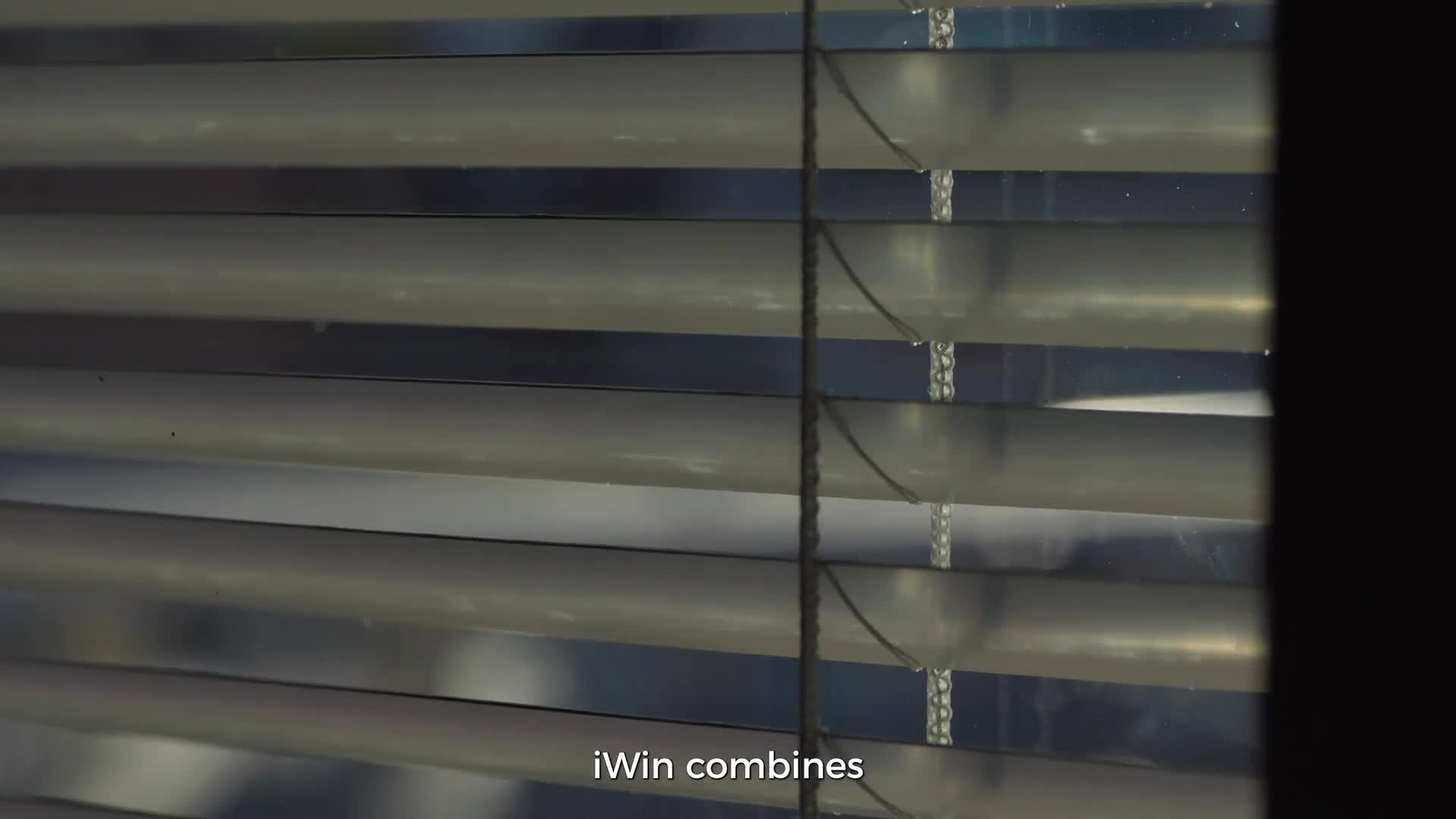
The blinds are delivered in a fully lowered position and offer tilt functionality. Manual control of slat orientation allows for see-through visibility and visual comfort would be assessed during the last part of the project through the end user experience. This activity is foreseen after the installation of the solar windows and reported in M48.
An aperture area efficiency of 7.4% has been measured in our non-accredited laboratory for small size solar windows based on CIGS solar cells technology. However, as previously mentioned within the first reporting period, the supplier of the solar cells went bankrupt, and the material is no longer available to manufacture the solar windows of the demonstration buildings. These will be produced with material from another supplier that provides solar cells with much lower efficiency (approx.. 2.5%) than originally expected during the preparation of the proposal, and therefore the initial objective of 7% efficiency cannot be met.
-
Activities related to production processes have been completed. The roll-to-roll infrastructures for a continuous lamination and slitting of photovoltaic semi-fabricates have been commissioned and validated. The design accounted for all electrical and mechanical aspects of the converting infrastructure, as well as the photovoltaic film material, ensuring the implementation of the specified processes.
-
iWin started to interface with local manufacturers, users, and other stakeholders by mapping and prioritizing them based on their relevance and influence. Conduct thorough research on the local market, including user needs, regulations, and existing solutions. Estimated progress of the activity remains at 20% and it is foreseen to attend industry events and initiate contacts and build relationships within the last of the project, to be completed by M48.
-
Most heritage authorities require that the IGU does not alter the building’s appearance, especially from the outside. Therefore, the insulated glass units have been designed to fit within the traditional frames without changing sightlines or glazing bars. The intervention is also designed to be reversible and the new frame materials must match the historical detailing. The estimated progress of the activity is 90%, to be completed when delivering solar windows for DC#1.
-
The Solar Windows will be demonstrated in DC#1 and DC#2 in operational conditions. The tender for the working group in DC#1 is now closed and currently estimated date for starting retrofitting works is on the 1st of April 2026. The installation process in DC#2 is currently on-going and the assessment is foreseen by the end of the project.
-
The change in the photovoltaic material supplier has adversely affected the performance of the solar window, please see section 4 above, thereby diminishing its market competitiveness. To mitigate this issue, a comprehensive technological enhancement is required. Additionally, further research must be undertaken to address critical aspects such as long-term reliability, certification compliance, and the aesthetic and functional expectations of end users
Estimated progress of interfacing with local manufacturers, users and other stakeholders remains at 25%. It is foreseen to attend industry events and initiate contacts and build relationships within the last of the project.
The estimated progress of addressing heritage requirements is 90%. To be completed when delivering solar windows for DC#1.
Finalize installation process of the active windows to demonstrate operations into real operation conditions.
Further research are currently been undertaken to address critical aspects such performance, long-term reliability, certification compliance, and the aesthetic and functional expectations of end users.
Expected Impact
-
iWin transforms building façades from passive energy liabilities into active contributors to the energy transition. By combining multifunctionality, durability and retrofit capability, iWin supports responsible resource use, minimises grey energy and enables scalable climate impact in dense urban environments.
-
Assuming a future target installed capacity of 160 Wp/m² (currently working on inorganic PV technologes to improve performance) and a conservative BIPV yield of 750–900 kWh/kWp·year, iWin generates approximately 120–145 kWh/m²·year of renewable electricity.
Using a Swiss grid emission factor of ~90 gCO₂/kWh, this corresponds to avoided emissions of approximately 11–13 kg CO₂/m²·year from electricity generation alone. Additional cooling energy savings of 15–30% in highly glazed buildings further increase climate benefits but are conservatively not fully quantified.
-
• PV panels: €250–350/m²
• External shading: €150–200/m²
Installation costs for traditional systems typically range from €195 to €245/m², including:
• Blind assembly: €25/m²
• Window installation: €120/m²
• PV installation: €50–100/m²
In comparison, iWin’s installation costs are estimated at €144/m², comprising:
• Window installation: €120/m²
• Additional 20% to account for the energy generation features: €24/m²
This results in a total installed cost of €1144–1644/m² for iWin, versus €895–1145/m² for traditional solutions[1].
Despite the higher component cost, iWin’s installation is significantly simpler (€144/m² vs. €195–245/m²), reducing labor requirements by 25–40%. This simplification, combined with the system’s reduced complexity, lower maintenance, improved architectural integration, and enhanced lifecycle value, may justify the premium.
Further analysis of demo case installations is required to assess real-world installation costs and potential long-term savings under operational conditions.
Sources include EnergieSchweiz and IEA PVPS
[1] Sources include EnergieSchweiz and IEA PVPS
-
Using iWin solar windows instead of conventional shading and photovoltaic (PV) systems can lead to significant reductions in maintenance costs.
Motorized external blinds typically require annual cleaning, mechanical inspections, and occasional repairs, with maintenance costs estimated between €10–20/m²/year. This corresponds to 5%–10% of the initial blind cost (€150–200/m²). In addition, conventional rooftop PV systems incur further maintenance costs for tasks such as inverter servicing and panel cleaning. The IEA-PVPS provides guidelines for the operation and maintenance of PV systems across various climates, reporting annual base O&M costs ranging from €6.5–16.5/kW/year. Assuming an average of 1 kW installed capacity per 7 m² for BIPV/window façades, this translates to approximately €1.0–2.5/m²/year for PV-related maintenance. As a result, the total maintenance cost for traditional systems (blinds + PV) is estimated at €11–23/m²/year.
In contrast, iWin integrates both shading and photovoltaic functionality within the insulated glazing unit (IGU). This sealed design eliminates exposure of shading elements to weather and protects PV components from external soiling and environmental degradation. As a result, iWin’s estimated maintenance costs are reduced to €5–10/m²/year, representing a 40–55% reduction compared to traditional systems. By protecting critical components and simplifying the building envelope interface, iWin delivers a low-maintenance solution for solar-active façades. These estimates are preliminary and should be validated through long-term monitoring of real installations.
-
Based on the simulation from ACCIONA and TAU, the primary energy consumption reduction from the solar window is 20% in one dwelling in DC#1 and 1% in one room in DC#2.