
Indoor Environmental Quality (IEQ)
The EPFL contribution to INPERSO focuses on the development and application of a performance-based Indoor Environmental Quality (IEQ) benchmarking and decision-support framework, combined with a sensor-driven recommendation system to support healthier and more comfortable indoor environments in residential and educational buildings.
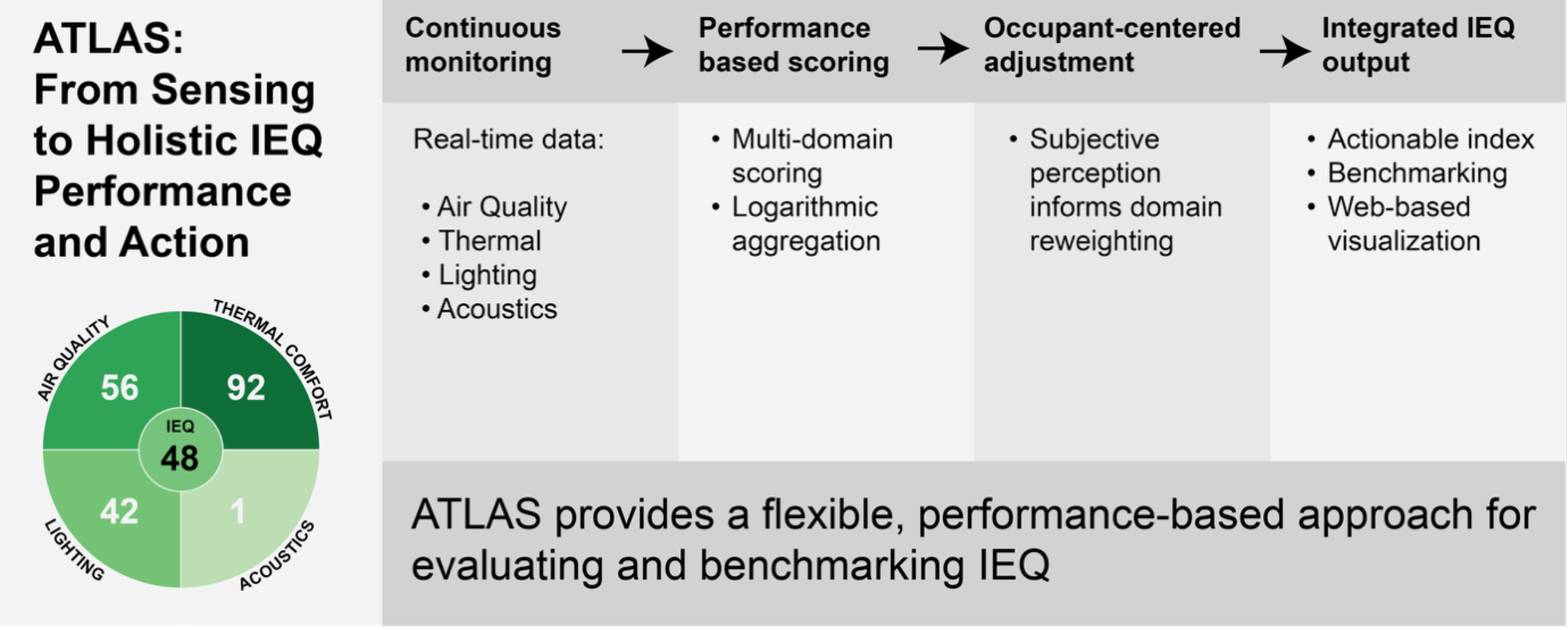
At the core of this work is ATLAS, a novel IEQ index that integrates four key IEQ domains—Indoor Air Quality (IAQ), Thermal Comfort, Lighting, and Acoustics—using data from validated low-cost sensors and occupant feedback surveys. Unlike traditional single-parameter approaches, ATLAS provides a holistic, scalable, and user-oriented assessment of IEQ, enabling meaningful comparisons across buildings and over time.
The framework is designed to evaluate IEQ before, during, and after renovation, supporting evidence-based assessment of renovation impacts on occupant comfort and well-being. In parallel, EPFL is developing a personalized recommendation system that translates real-time sensor data and IEQ index outputs into actionable guidance for occupants and building operators via in-space interfaces (e.g. tablets). Together, these technologies support informed behavioral and technical interventions, bridging the gap between sensing, interpretation, and action.
Objectives
Develop a robust and scalable methodology for benchmarking IEQ in residential buildings within INPERSO
Enable sensor-driven, personalized recommendations to guide occupant behavior and technical interventions
Create a novel integrated IEQ index (ATLAS) combining physical measurements and occupant feedback
Quantify the impact of recommended interventions on overall IEQ performance
Demonstrate how building renovation affects IEQ, comfort, and well-being
Replicate and validate the IEQ benchmarking tool in three Swiss schools
Work Carried Out So Far & Milestones Achieved
-
Integrated four IEQ components (IAQ, thermal comfort, lighting, acoustics)
Combines low-cost sensor data with occupant survey feedback
Designed as a performance-based benchmarking tool
-
Validated low-cost measurement methods deployed
IEQ data collected in three residential demonstration buildings
-
IEQ surveys designed, collected, and incorporated into the ATLAS framework
-
-
Remaining Work
Apply the ATLAS IEQ index pre-, during, and post-renovation in selected INPERSO buildings
Contribute results to INPERSO dissemination, website content, and cross-partner analyses
Conduct replication studies in three Swiss schools to test robustness and scalability
Deploy and test the personalized recommendation system, including:
Integration of real-time sensor data
Tablet-based user interfaces for occupants
Behavioral guidance and technical recommendations
Quantify the IEQ improvements resulting from proposed interventions
Expected Impact
-
A validated, transferable IEQ benchmarking methodology suitable for large-scale deployment
Demonstration of the added value of low-cost sensing combined with occupant feedback
-
Improved occupant comfort, well-being, and awareness of indoor environmental conditions
Empowerment of occupants through clear, actionable recommendations
Strengthened credibility of INPERSO as a project delivering measurable IEQ outcomes
-
Support for renovation strategies that improve IEQ while avoiding unnecessary energy penalties
Evidence-based decision-making for healthier indoor environments