
ECO-I is a unified RESTful API platform for energy and indoor environmental quality management in buildings. It consolidates heterogeneous data streams (real-time and historical) into a single interface, that powers end-to-end services, including monitoring, data analytics, energy optimization, asset health monitoring, and indoor air quality assessment.
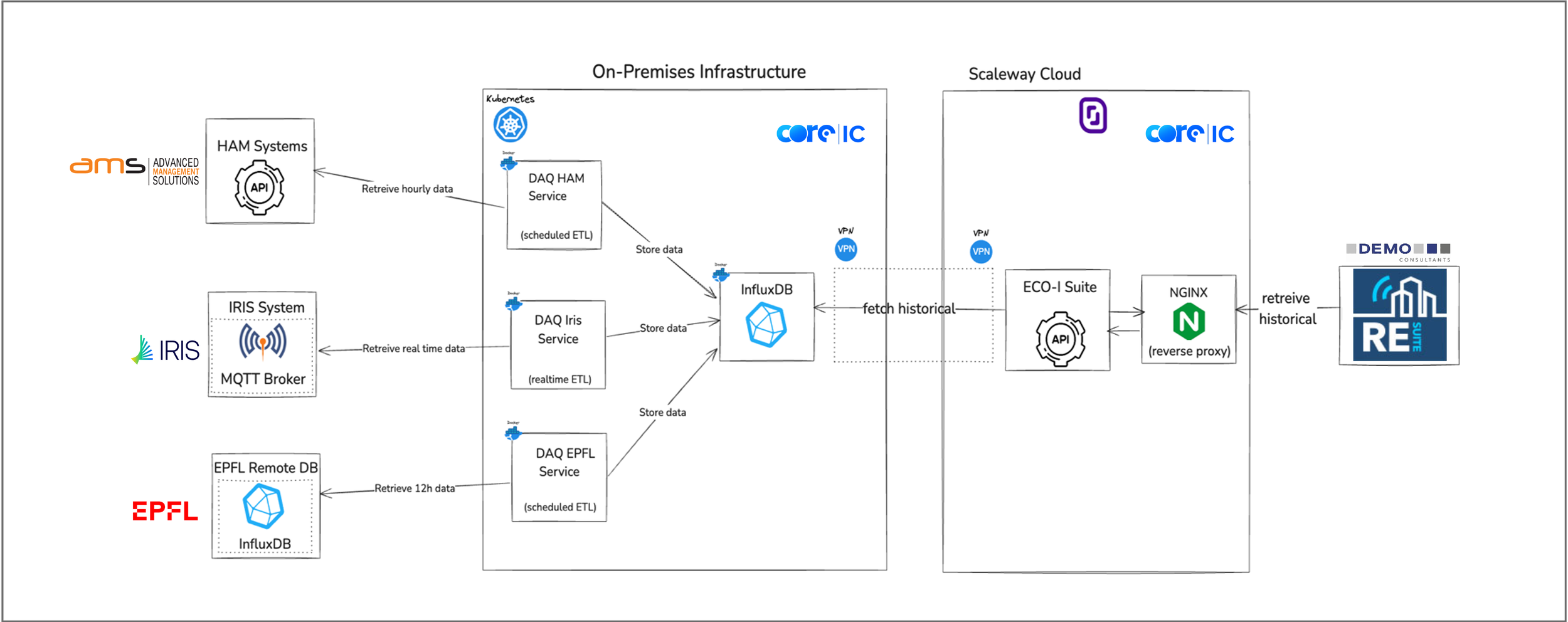
ECO-I integrates three core capabilities:
a low-cost, low-energy Wireless Sensor Network (IRIS) for energy measurements
the Multi-Stage Energy Consulting System (MuSECS) (CORE) that provides data analytics, energy optimization, and asset health monitoring of critical devices
the ATLAS IEQ Index, which evaluates indoor environmental quality and supports occupant-focused recommendations (EPFL)
Data from the demo-case systems and third-party services are ingested through dedicated ETL pipelines into time-series storage and exposed via secure endpoints. By acting as a single point of reference for raw measurements, derived statistics, and model outputs, ECO-I supports interoperability with external applications (e.g. RE-SUITE), facilitating scalable, data-driven decision-making for energy efficiency and indoor environmental comfort. It is designed to be extensible as new devices and use-cases are integrated across the project.
Objectives
The ECO-I suite aims to provide a unified, interoperable backbone for building data and analytics within INPERSO, enabling seamless integration of measurements and AI-driven insights into operational decision-making:
Provide a single integration layer that unifies data acquisition (IRIS’s WSN, external sources) with model outputs (MuSECS, ATLAS IEQ assessment) within the INPERSO ecosystem.
Enable interoperable access to raw measurements, derived statistics, and model outputs through a standard REST API to support the INPERSO interface (RE-SUITE) and third‑party tools.
Support data-driven decision-making that reduces energy costs and while maintaining or improving occupants’ comfort levels.
Work Carried Out So Far & Milestones Achieved
At this stage, the ECO-I suite has been designed and implemented as a unified integration layer that connects building data acquisition with analytics and model outputs developed under various tasks within the project. The work completed so far includes:
-
Defined ECO-I as the common API layer that brings together sensor data acquisition (WSN / HAM), MuSECS analytics, optimization & asset health monitoring outputs, and EPFL IEQ assessment
-
Designed and implemented the ECO-I architecture using three clear layers: Data Sources → Internal Components → Data Consumers, enabling both real-time monitoring and historical data retrieval
-
Implemented reliable data ingestion through dedicated ETL pipelines:
Scheduled API ingestion (HAM Systems)
Real-time MQTT ingestion (IRIS)
Remote database synchronization (EPFL Influx DB)
______________
Consolidated all incoming streams into a unified on-premises time-series database (Influx DB)
-
Established a production-ready deployment setup with:
Kubernetes-managed services
-
Secure connectivity between on-premises and cloud services via VPN tunnel and NGINX
Access to the API is protected with Bearer token authentication
-
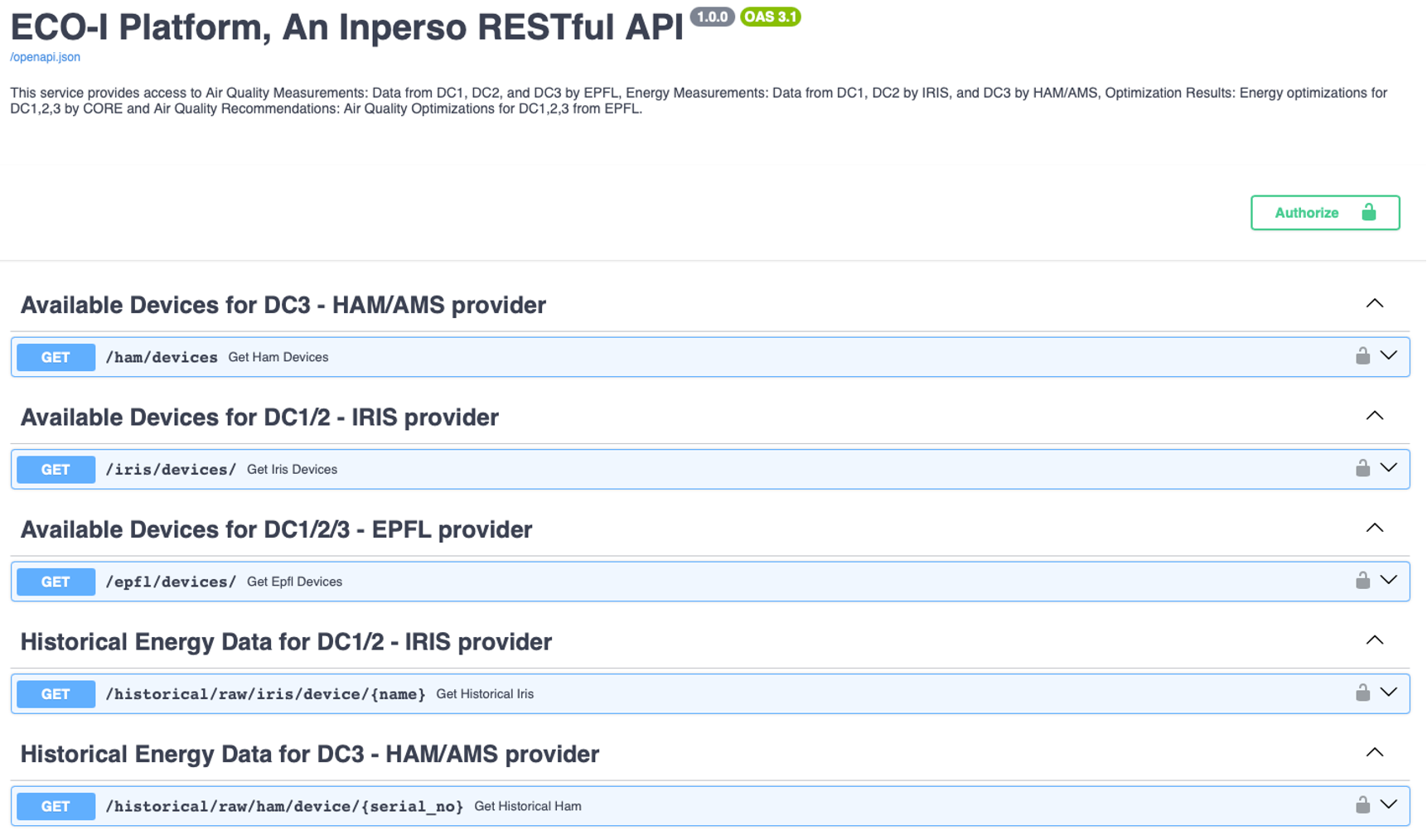
Deployed and documented the initial set of ECO-I endpoints, including:
Raw Data Endpoints: electricity measurements and indoor air quality measurements for all DCs
Energy Insight Endpoints: statistics and analysis of raw measurements for all DCs
Energy Optimization Endpoint: optimization model predictions for DC3
Asset Health Monitoring Endpoint: anomaly detection model predictions for DC3
IEQ Optimization Endpoint: IEQ index + suggestions
-
Conducted by partners and CORE evaluating ECO-I quality of services , endpoints and performance.
Published API documentation and integrated ECO-I with the INPERSO interface (RE-SUITE)
Remaining Work
Until project completion, ECO-I will be further strengthened and extended to ensure full operational maturity across all INPERSO demo cases. The remaining work focuses on completing the deployment of the full planned endpoint set and hardening the API for production-scale use.
As the corresponding models become available, the remaining Energy Optimization and Asset Health Monitoring endpoints will be rolled out for DC1 and DC2, ensuring consistent optimization and health-status services across sites, while IEQ scoring will be refined using occupant survey feedback.
In parallel, data acquisition at the demo cases will be continuously refined and stabilized, as additional metering or system changes are introduced over time. This includes integrating new or updated data sources and improving resilience to outages and missing data to ensure continuous, reliable ingestion into the system.
Expected Impact
-
ECO-I is expected to generate strong economic value primarily through cost reduction. By enabling energy optimization, and real-time asset health monitoring, the system significantly can reduce operational expenditures (OPEX) for public building operators, municipalities, ESCOs, and facility managers. Early anomaly detection and predictive maintenance minimize equipment downtime, extend asset lifetime, and reduce unnecessary maintenance and replacement costs. Its integrated, interoperable, and REST API-based architecture enhances its competitiveness within the growing Building Energy Management Systems market by offering a holistic solution.
-
ECO-I delivers substantial social benefits by improving Indoor Environmental Quality (IEQ), increasing energy awareness, and supporting public-sector sustainability efforts. Through the integration of a holistic IEQ index, the system enhances occupants’ comfort, well-being, and health by optimizing thermal conditions and indoor air quality. This may result in fewer health-related absences and improved productivity in workplaces, schools, and public buildings. Furthermore, real-time energy visualization and analytics promote transparency and foster behavioral change among facility managers and building users, encouraging more responsible energy use. By supporting municipalities and public authorities in achieving green building certifications and smart city objectives, ECO-I strengthens governance, sustainability accountability, and public trust in energy-efficient infrastructure management.
-
Environmentally, ECO-I supports measurable reductions in CO₂ emissions by enabling day-ahead operational planning that explicitly accounts for carbon intensity alongside energy cost. Through is energy optimization module, the platform computes an energy dispatch schedule that can shift flexible loads and prioritize lower-emission operating periods when this is feasible within site constraints. This reduces avoidable consumption during high-carbon or high-price hours and improves the alignment of energy use with cleaner electricity supply conditions. In parallel, ECO-I’s monitoring and analytics module supports earlier detection of degradations that often lead to energy waste, enabling more timely corrective actions and maintaining efficient operation over time.