Author: Dusan Licina, Associate Professor of Indoor Environmental Quality | EPFL
Over the past decade, our ability to monitor indoor environments has advanced considerably. Sensors can now continuously measure carbon dioxide, particles, temperature, humidity, light, sound, and many other parameters at increasingly affordable costs. But collecting more data does not automatically lead to healthier or better-performing buildings.
To understand how monitoring can create broader impact, I find it useful to think in terms of three connected layers: sensing, indexing, and benchmarking:
· Sensing provides visibility. It tells us what is happening inside a building.
· Indexing provides interpretation. It translates multiple streams of measurements into indicators that can support decisions.
· Benchmarking enables comparison and improvement. It helps us understand how a building performs relative to comparable buildings, identify leaders and laggards, and track progress over time.
Of these three layers, indexing may be the least visible, but it is the essential bridge between collecting data and acting on it.
The challenge of evaluating indoor environmental quality
Indoor environmental quality is inherently multidimensional. It includes air quality, thermal comfort, lighting, and acoustics. These domains are frequently assessed separately. Yet occupants experience them simultaneously. A room may have a comfortable temperature and good lighting but still provide a poor overall environment because of excessive noise or inadequate air quality.
This creates an important methodological question: How can we combine different dimensions of indoor environmental quality into one meaningful assessment without allowing good performance in some areas to hide a serious problem in another?
A simple average does not fully address this challenge. High scores in several domains can compensate for critically poor performance elsewhere. At the other extreme, using only the lowest-performing domain discards valuable information about the rest of the indoor environment. Our newly published paper in Building and Environment proposes a way forward.
Introducing ATLAS
The ATLAS Index: Air quality, Thermal comfort, Lighting, and Acoustics Scale, is a performance-based framework for the integrated evaluation and benchmarking of indoor environmental quality.
Rather than evaluating a building primarily through its design characteristics or the technologies it contains, ATLAS evaluates the indoor environmental conditions that are actually achieved. Continuous measurements are translated into comparable scores for the four environmental domains. These can be examined separately, followed over time, or combined into an overall ATLAS score.
A key feature of the framework is how these scores are aggregated. The method gives greater influence to weak-performing domains while still accounting for the performance of all four. The principle is intuitive: excellent lighting and comfortable temperatures should not make persistently poor air quality disappear within an average. At the same time, the overall assessment should distinguish between a space that performs poorly in only one domain and one that performs poorly across several. ATLAS is designed to preserve this balance.
Making complex data interpretable
We also developed an open, web-based tool to make the framework accessible and visually interpretable (Figure 1). The ATLAS Overview provides a synthetic representation of performance across the four domains. The ATLAS Analytics view allows users to examine individual parameters and their time-evolution in detail.
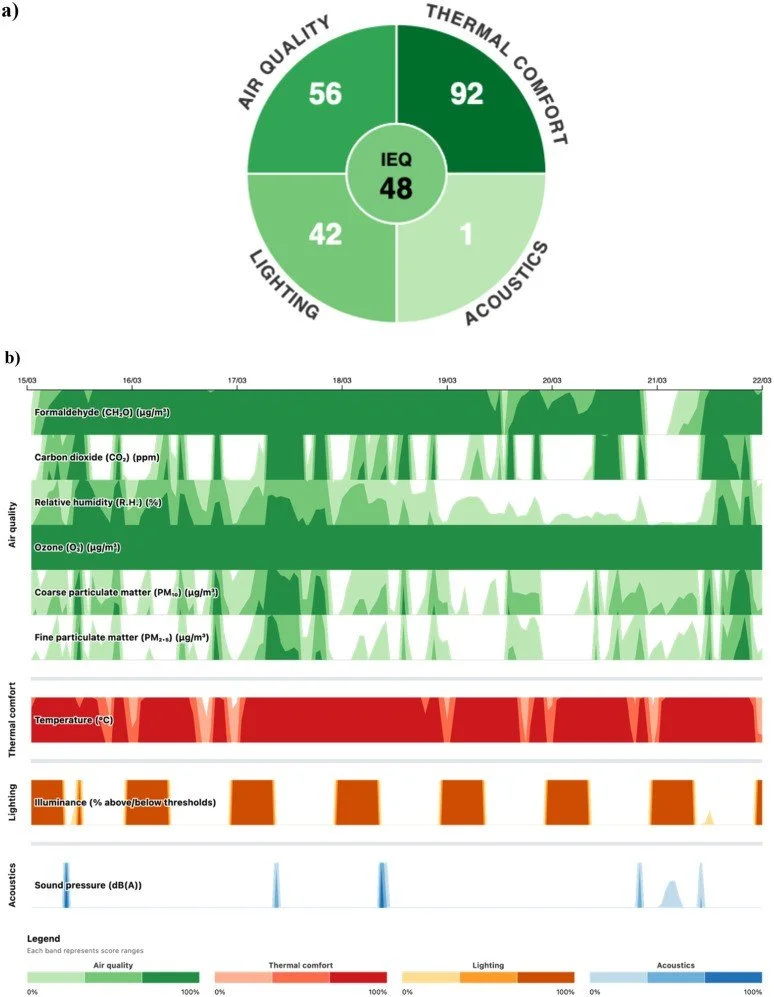
Figure 1. A web-based tool for visualizing the ATLAS index (https://epfl-enac.github.io/hobel-atlas-score/). a) ATLAS Overview: general, synthetic visualization of scores; b) ATLAS Analytics: finer-grained analytical breakdown using a horizon-style time-series visualization, in which the vertical scale of each parameter is compressed into colored bands to reduce figure height while preserving temporal trends and score variations. Darker colors and higher scores represent better indoor environmental conditions.
The aim is not merely to produce another score. It is to help researchers, building operators, designers, and other decision-makers identify when performance deteriorates, understand which environmental domain is driving the result, and determine where an intervention may be needed.
The framework was demonstrated using long-term measurements from occupied apartments in Valencia, Spain. This application illustrates how ATLAS can reveal temporal variations, differences between spaces, and the environmental conditions limiting overall performance.
From indexing to benchmarking
ATLAS is not intended to replace indoor air quality guidelines, thermal comfort standards, or other requirements for individual parameters. These remain essential. Instead, it provides an additional interpretive layer that can make multidimensional and time-resolved building data easier to understand and compare.
This is especially relevant as continuous monitoring becomes more widespread. At the level of one building, an index can support diagnosis and operational improvement. Across larger portfolios, standardized indices may eventually enable benchmarking between similar buildings, renovation approaches, or operational strategies. Such comparisons will require careful consideration of climate, building type, occupancy, outdoor conditions, and other contextual factors. Data quality, privacy, and equitable representation will also be critical.
Nevertheless, the broader pathway is clear: Sensing allows us to observe indoor environments. Indexing helps us understand them. Benchmarking can help us improve them. ATLAS is our contribution to strengthening that crucial middle step.
A collaborative effort
This work was led by three excellent researchers: Dr Bowen Du, Dr Sarah Crosby, and Dr Cairan Van Rooyen. I am deeply grateful for the complementary expertise, creativity, and persistence they brought to the development of the framework.
The research was supported by INPERSO Project—Industrialised and Personalised Renovation for Sustainable Societies, funded by the European Union’s Horizon Europe programme under Grant Agreement No. 101069820.
Our paper, “ATLAS: A Performance-Based Index for Integrated Evaluation and Benchmarking of Indoor Environmental Quality,” is now available in Building and Environment: