Bringing post-occupancy evaluation up front to enhance energy efficiency in residential buildings
As Europe strives to drastically reduce emissions from the building sector, ensuring that residential buildings perform as designed remains a persistent challenge. This recent scientific publication, authored by Raúl Castaño-Rosa and Dara Nerweyi (TAU) and supported by the INPERSO Project, investigates how Post-Occupancy Evaluation (POE) can be repositioned from a late-stage assessment tool to a core driver of design and decision-making in residential buildings.
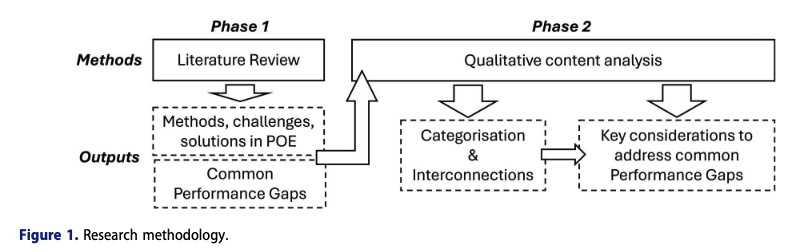
Through a comprehensive systematic literature review of over 100 case studies, the research demonstrates that energy and comfort performance gaps are not only technical issues, but the result of fragmented decision-making, limited stakeholder engagement, and insufficient user-centred approaches.
Highlights of the Research
Performance Gaps Go Beyond Energy
The study shows that gaps frequently affect not only energy consumption, but also indoor air quality, thermal comfort, daylighting, user satisfaction, and return on investment.Barriers to Effective POE
A lack of standardised methodologies, limited continuous data collection, and weak engagement of building users significantly hinder the effectiveness of POE in residential projects.User Behaviour Matters
Findings confirm that building users play a critical role in actual performance outcomes, often explaining discrepancies between predicted and real energy use.From Linear to Feedback-Loop Processes
The research proposes a shift from today’s static, linear project culture toward a dynamic, feedback-loop approach, integrating POE principles from the earliest project phases.
Key Insights and Challenges
Performance gaps often originate during planning and design, long before buildings are occupied.
Decisions based solely on simulations and standard occupancy assumptions frequently fail to reflect real-life conditions.
Limited communication between stakeholders and insufficient user involvement amplify both procurement and operational gaps.
By introducing POE earlier and maintaining continuous feedback throughout design, construction and operation, these gaps can be significantly reduced.
A Call to Action for the Building Sector
The publication calls on policymakers, designers, developers and researchers to rethink how building performance is evaluated. Integrating user-centric POE practices upfront, supported by continuous qualitative and quantitative data, can lead to more energy-efficient, resilient and user-friendly residential buildings.
Aligned with INPERSO’s vision, this approach supports evidence-based decision-making and helps ensure that renovation and construction efforts deliver real, measurable impact—both for the climate and for people.
Information About the Full Publication
Title: Bringing post-occupancy evaluation up front to enhance energy efficiency in residential buildings
Authors: Raúl Castaño-Rosa, Dara Nerweyi
Journal: Building Research & Information
Funding: Horizon Europe – INPERSO Project (Grant Agreement No. 101069820)